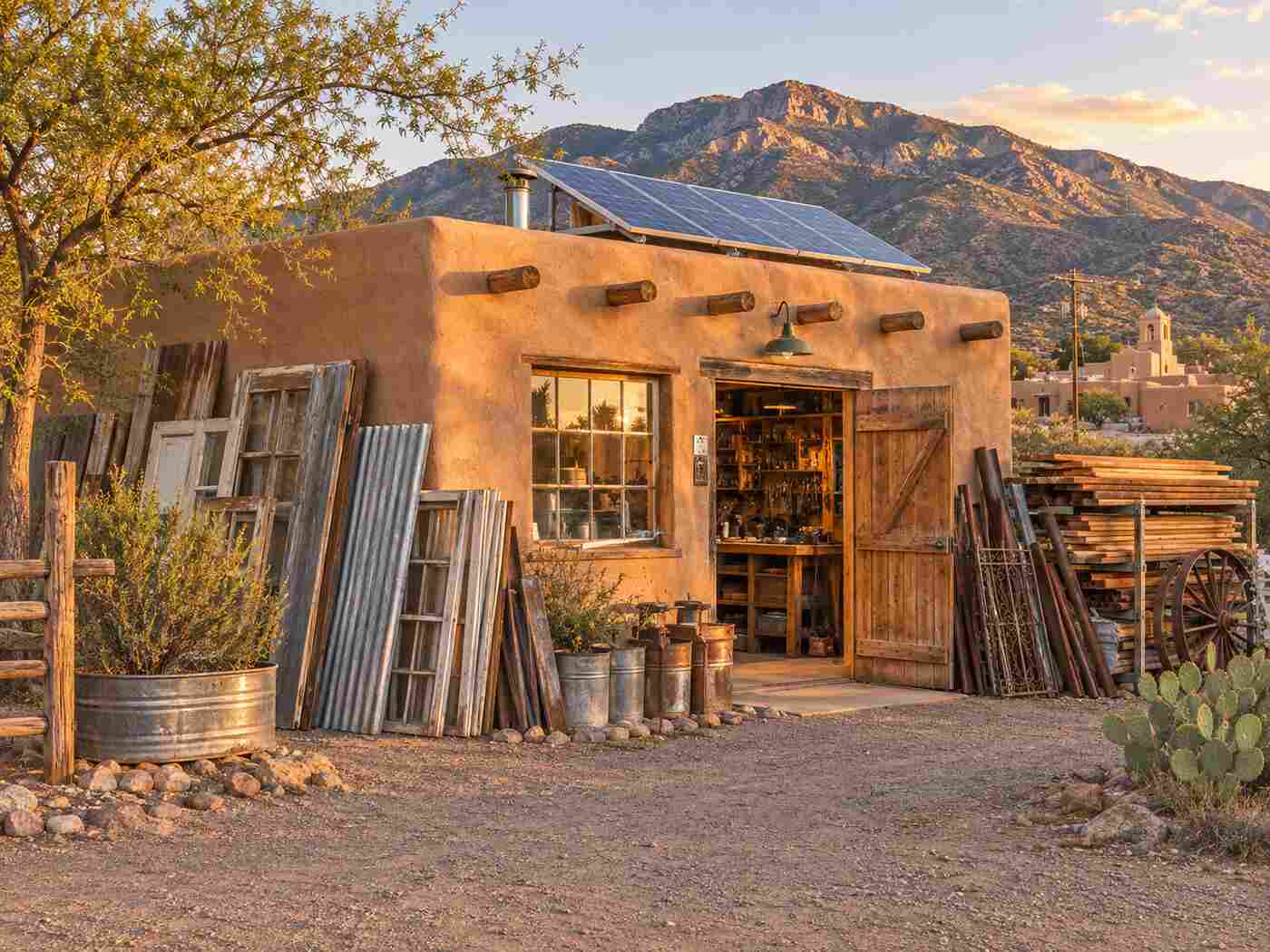
What this site is: an independent guide to post-consumer DIY living in the desert, with every fact linked to its source. Looking for Holy Scrap? Holy Scrap was the blog and shop of a couple living in Truth or Consequences, New Mexico, from 2006. This site is not the original Holy Scrap, does not sell anything and has no connection to its former owners.
Hot Springs Scrap Notes covers the practical side of living well on less: keeping food cold with a fraction of the usual electricity, getting more years out of batteries, reusing shipping pallets safely, eating a few well-known desert plants with care, and understanding why waste cooking oil is not a simple free fuel. The old Holy Scrap blog wrote about many of these projects from a small hot springs town on the Rio Grande. We picked up the same subjects and rebuilt them as reference guides, checked against government agencies, extension services, university researchers and long-running technical sources.
Art-and-music gatherings have a big following in Thailand, where festivals such as Wonderfruit mix both. To time a trip around a festival, SiamFest lists Thailand festival dates for 2026-2027 with trip plans.
We do not write about our own experiments, because we have not run them. Instead each guide sets out what the measured evidence says, where hobbyist claims run ahead of the data, and what the safety limits are. Where sources disagree, we say so and show both numbers.
Start here
- Chest freezer to fridge conversion: how an external thermostat turns a chest freezer into a very efficient refrigerator, what owners have measured, and the food safety limits.
- Lead-acid battery desulfation: what sulfation is, when an equalizing charge can help, why pulse desulfators are disputed, and how nickel-cadmium tool packs differ.
- Truth or Consequences hot springs history: from Palomas Hot Springs to the 1950 radio rename, the bathhouse district and the pressure on the geothermal water.
- Pallet wood reuse and ISPM 15 stamps: how to read the treatment mark, why methyl bromide pallets stay out of the house, and which pallets to leave alone.
- Edible desert plants of New Mexico: purslane, mesquite pods and the legal and health story of Mormon tea, with identification and preparation cautions.
- Waste vegetable oil as fuel: straight vegetable oil versus biodiesel, what the Department of Energy says about engine damage, and why biodiesel is a different product.
How the guides work
Every article opens with a short summary, explains key terms, and closes with key takeaways, common questions and a full list of sources. Numbers in the text come from the linked sources and carry their dates. Illustrations are generated images and are labelled as such. They show the kind of scene being described, not the actual objects or places in the sources.
The guides are written for readers who like to repair and reuse: off-grid homeowners, makers, gardeners, students and visitors to Truth or Consequences. None of them is a substitute for an electrician, a mechanic, a doctor or a local extension agent. Where a project carries real risk, such as lead and sulfuric acid in batteries, fumigated wood or plants with drug-like effects, the guide says so plainly and points to the official guidance.
About the old site
The Holy Scrap blog described itself as creating a post-consumer life in Truth or Consequences, making its own fuel, power, food, medicine, building materials and domestic goods. Its archive covered chest fridges, battery desulfators, pallet furniture, wild food and biofuel. When the old domain lapsed, those pages went offline. Links that once pointed to the old blog posts now lead to the closest matching guide here, and pages with no matching subject are marked as gone. Read more on our About page, including our editorial standards and how we use AI tools and illustrations.